Skip to content
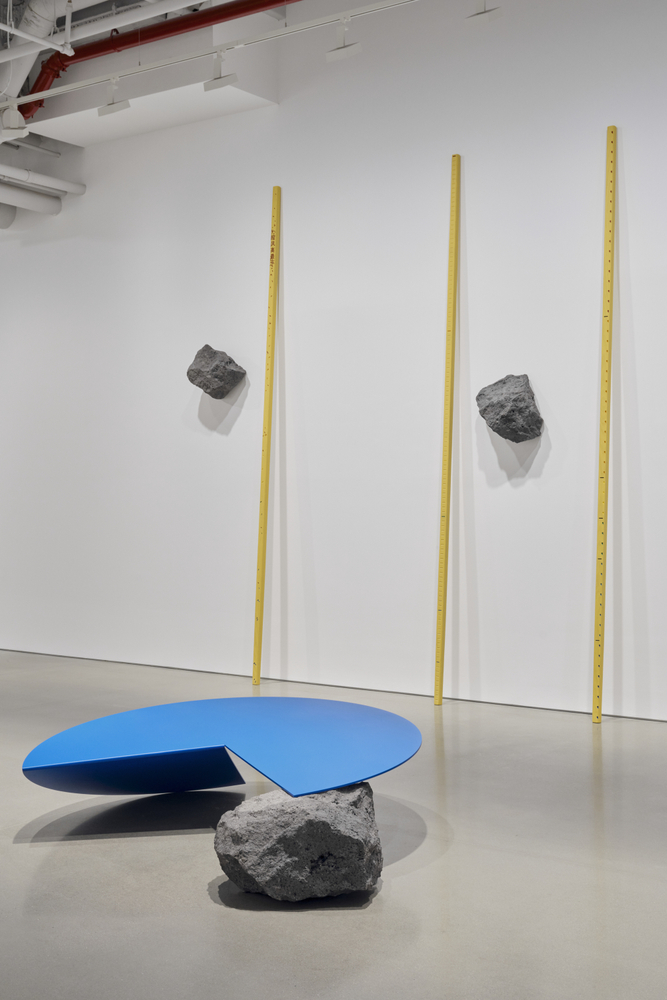
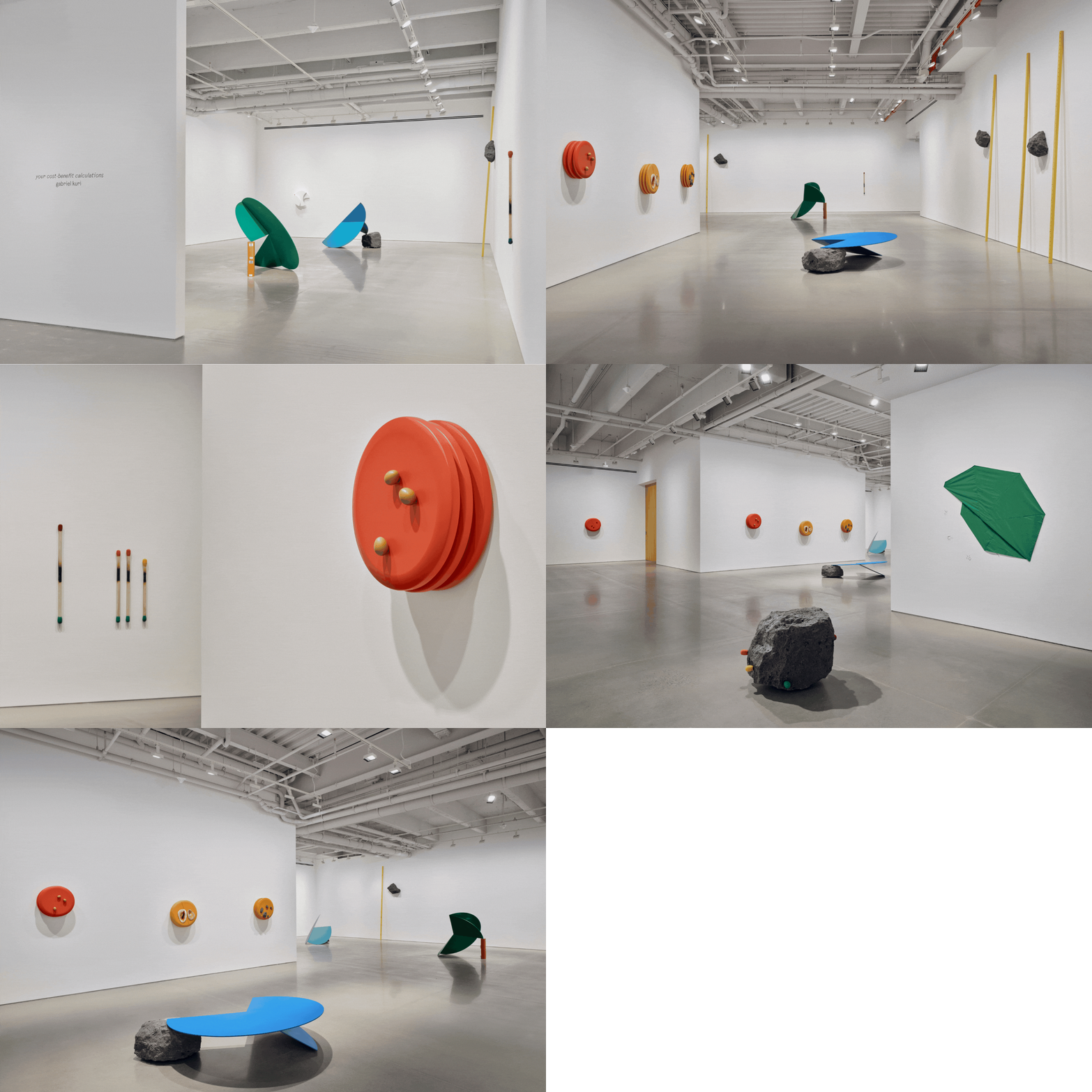
Installation view of your cost-benefit calculations, kurimanzutto, New York, 2026

Installation view of your cost-benefit calculations, kurimanzutto, New York, 2026

On the occasion of your cost-benefit calculations, Gabriel Kuri’s first exhibition at kurimanzutto, New York, From the Archive revisits a selection of exhibitions from his three-decade career. Rather than following a linear chronology, this edition brings together projects through recurring concerns that structure his practice: the systems that order experience, material tensions, the residues of exchange, and the mechanisms of prediction that shape our sense of the future. These are not fixed categories but provisional frameworks through which Kuri continually renegotiates objects and ideas. What emerges is a circulation of thought—like the receipts, volcanic rocks, shells, and everyday materials that move through his sculptures—rendering value, classification, and anticipation tangible in material form.

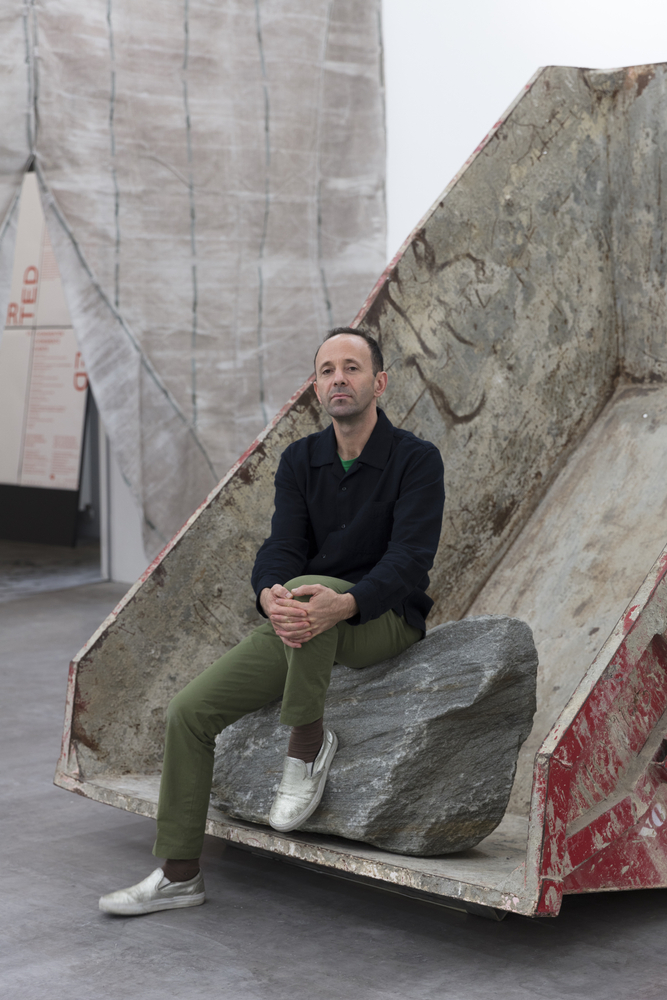
Portrait of Gabriel Kuri, 2019.
Photo by Andrea Rossetti.

Portrait of Gabriel Kuri, 2019.
Photo by Andrea Rossetti.

Born in Mexico City in 1970, Kuri began shaping his artistic path at sixteen, when he joined a small group that met weekly at Gabriel Orozco’s home—alongside Damián Ortega, Dr. Lakra, and Abraham Cruzvillegas—where conversation, shared readings, and reflection on what it meant to be an artist proved more formative than formal instruction. After completing his BA in Visual Arts at UNAM's Escuela Nacional de Artes Plásticas (National School of Visual Arts) in Mexico City, he moved to London in 1993 to pursue an MFA at Goldsmiths. He returned to Mexico in the late 1990s and relocated to Brussels in 2003, where his focus on sculpture and materially grounded processes became central to his practice. After several years in Los Angeles, he returned to Brussels, where he is based today.

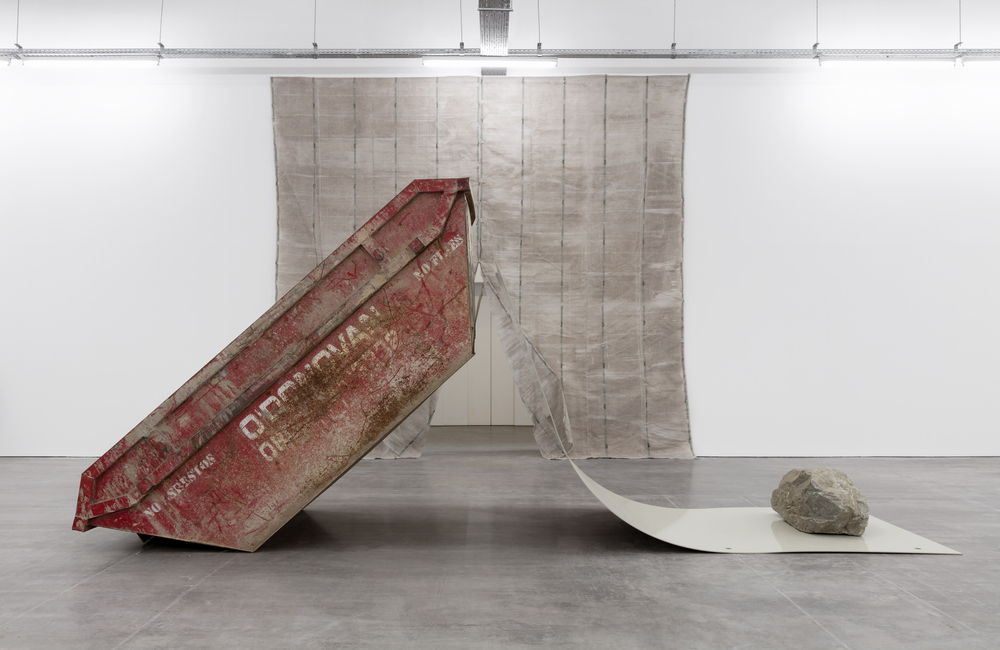
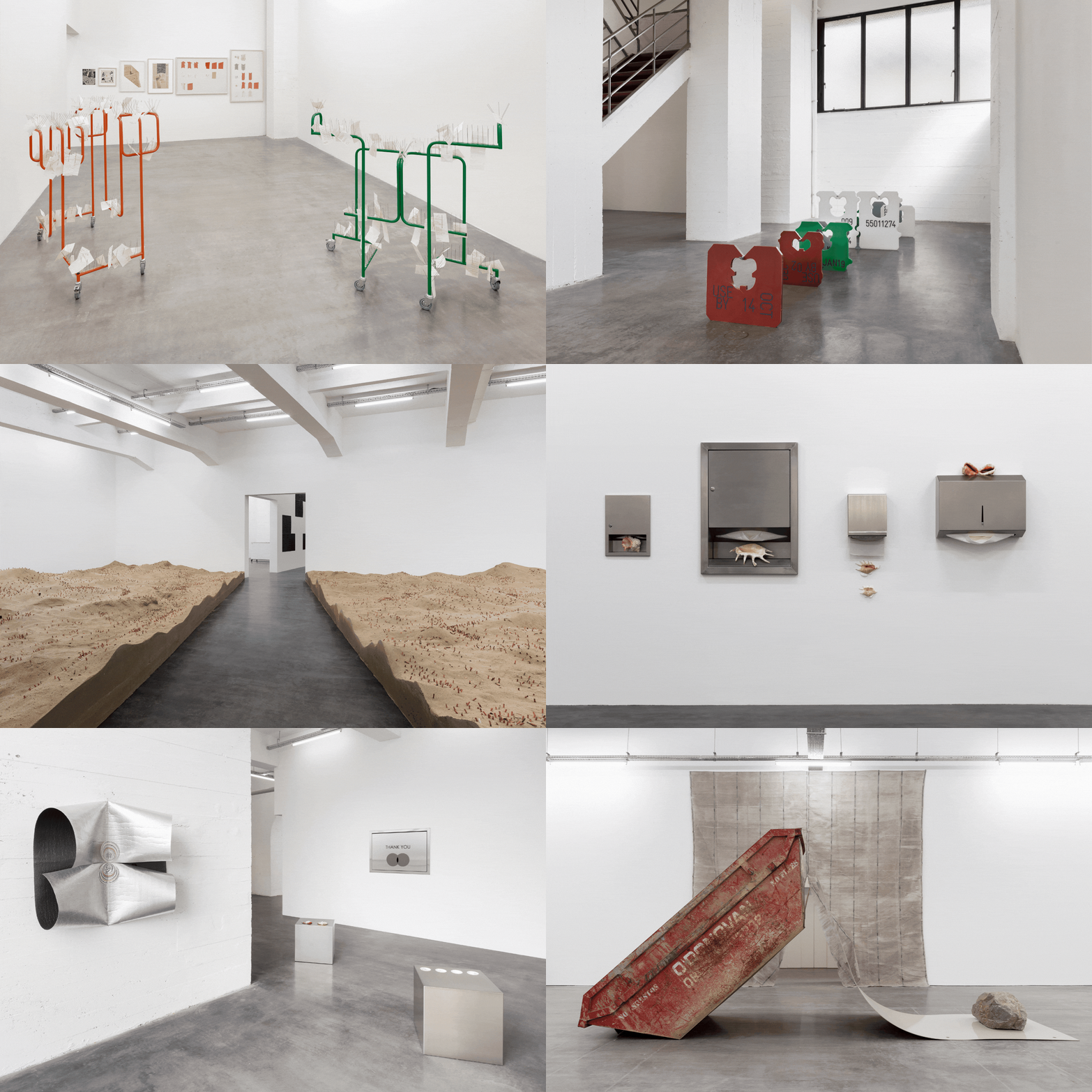
Installation view of Gabriel Kuri: Sorted, Resorted, WIELS Contemporary Arts Center, Brussels, Belgium, 2019

Installation view of Gabriel Kuri: Sorted, Resorted, WIELS Contemporary Arts Center, Brussels, Belgium, 2019

Across these relocations, Kuri’s work remains attentive to how economic, bureaucratic, and predictive systems structure everyday life—and how materials can make those structures tangible. Over the past three decades, he has repurposed found objects, juxtaposed consumer goods with abstract or weathered forms, enlarged and recast familiar shapes, and worked with both craftspeople and industrial fabrication. These strategies coexist within a non-hierarchical approach that treats sculpture as an open-ended discipline for engaging critically with the material world.

Ordering Principles

Daily life unfolds within ordering mechanisms so familiar they often escape notice: the numbered ticket at a cloakroom, the colored bag assigned to recycling, the protocols that sort and regulate everyday activity. These administrative and bureaucratic structures shape how objects circulate and how bodies inhabit space. In the 2000s, Kuri began appropriating and reconfiguring such systems, making their logic explicit.

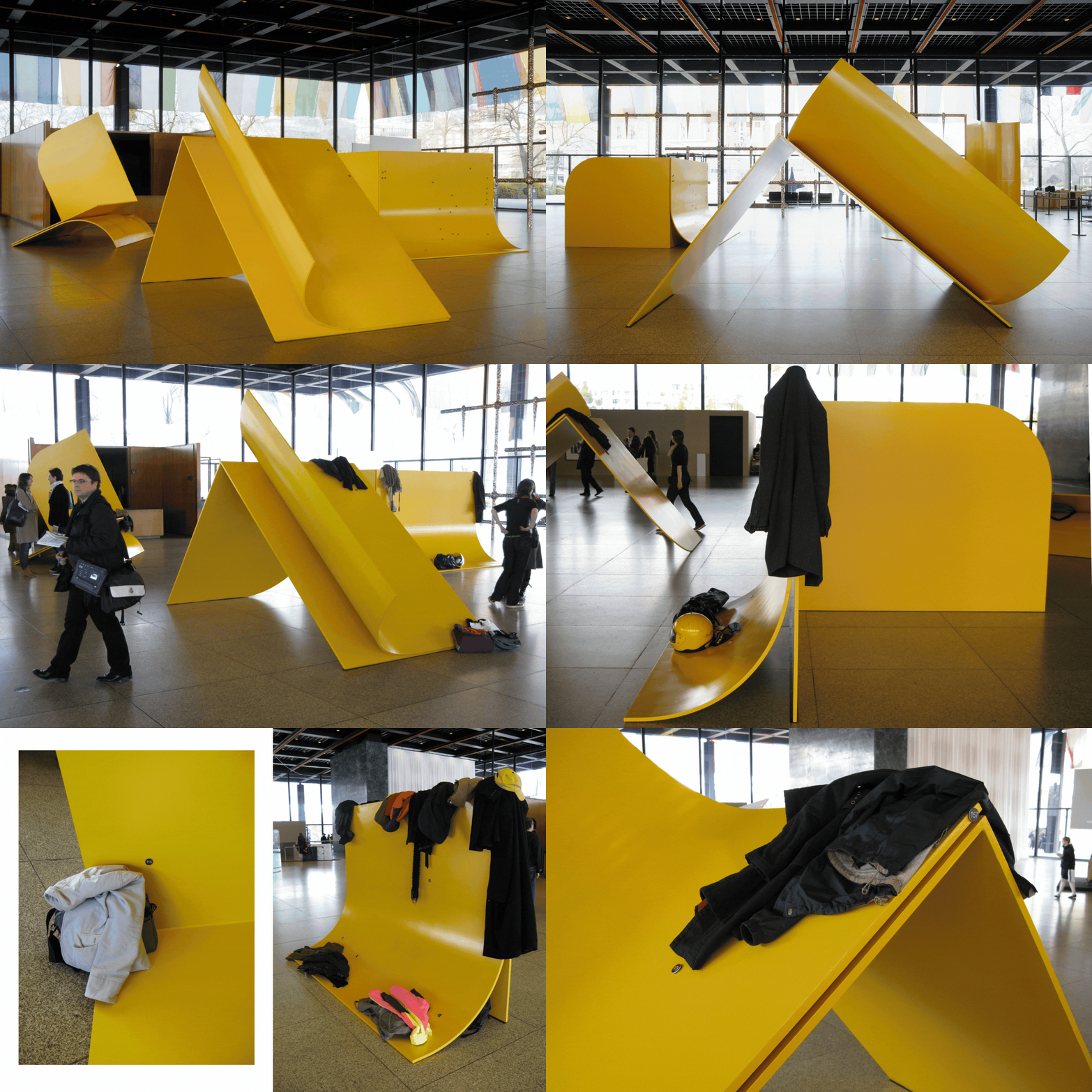
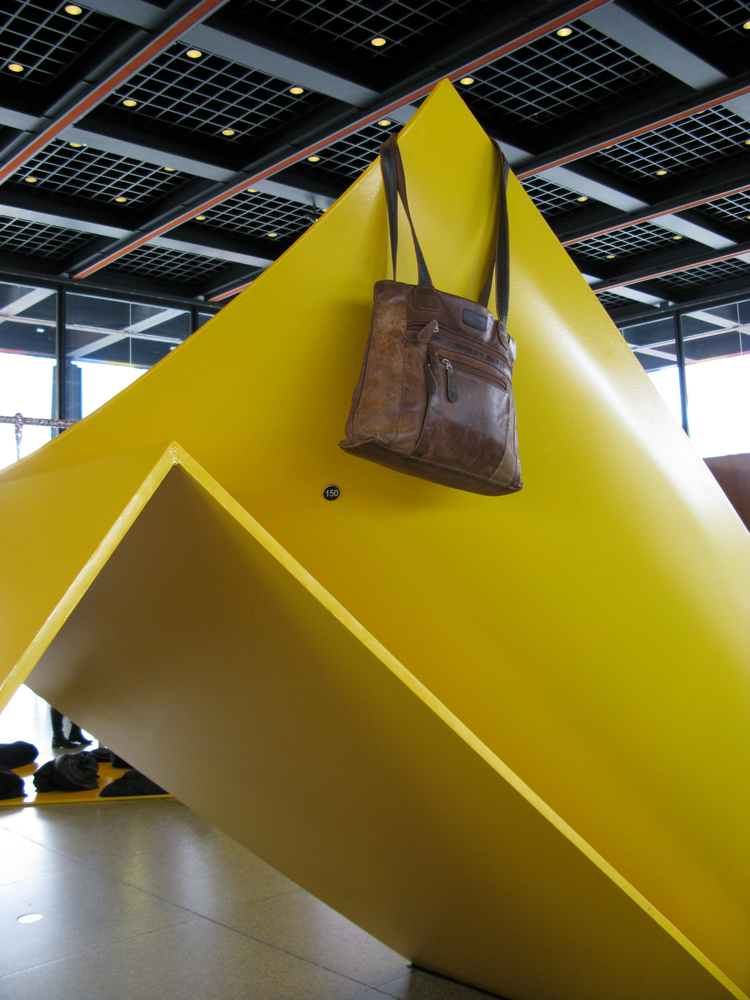
Installation views of items in care of items, as part of When things cast no shadow, 5th Berlin Biennial, Neue Nationalgalerie, 2008

Installation views of items in care of items, as part of When things cast no shadow, 5th Berlin Biennial, Neue Nationalgalerie, 2008

Installation view of items in care of items, as part of When things cast no shadow, 5th Berlin Biennial, Neue Nationalgalerie, 2008

Installation view of items in care of items, as part of When things cast no shadow, 5th Berlin Biennial, Neue Nationalgalerie, 2008

In items in care of items (2008), presented at the 5th Berlin Biennial at the Neue Nationalgalerie, abstract sculptural elements functioned as a working coat check. Bright yellow metal structures fitted with numbered magnets invited visitors to deposit and retrieve their belongings on these shapes that imagined sculpture as a provisional site of custody and exchange. Installed within Mies van der Rohe’s glass hall, what typically operated at the museum’s periphery was brought to its center, implicating viewers in the choreography of trust, categorization, and responsibility that underpins public life. The work exposes the infrastructures we collectively construct and inhabit, while suggesting they might be reorganized.

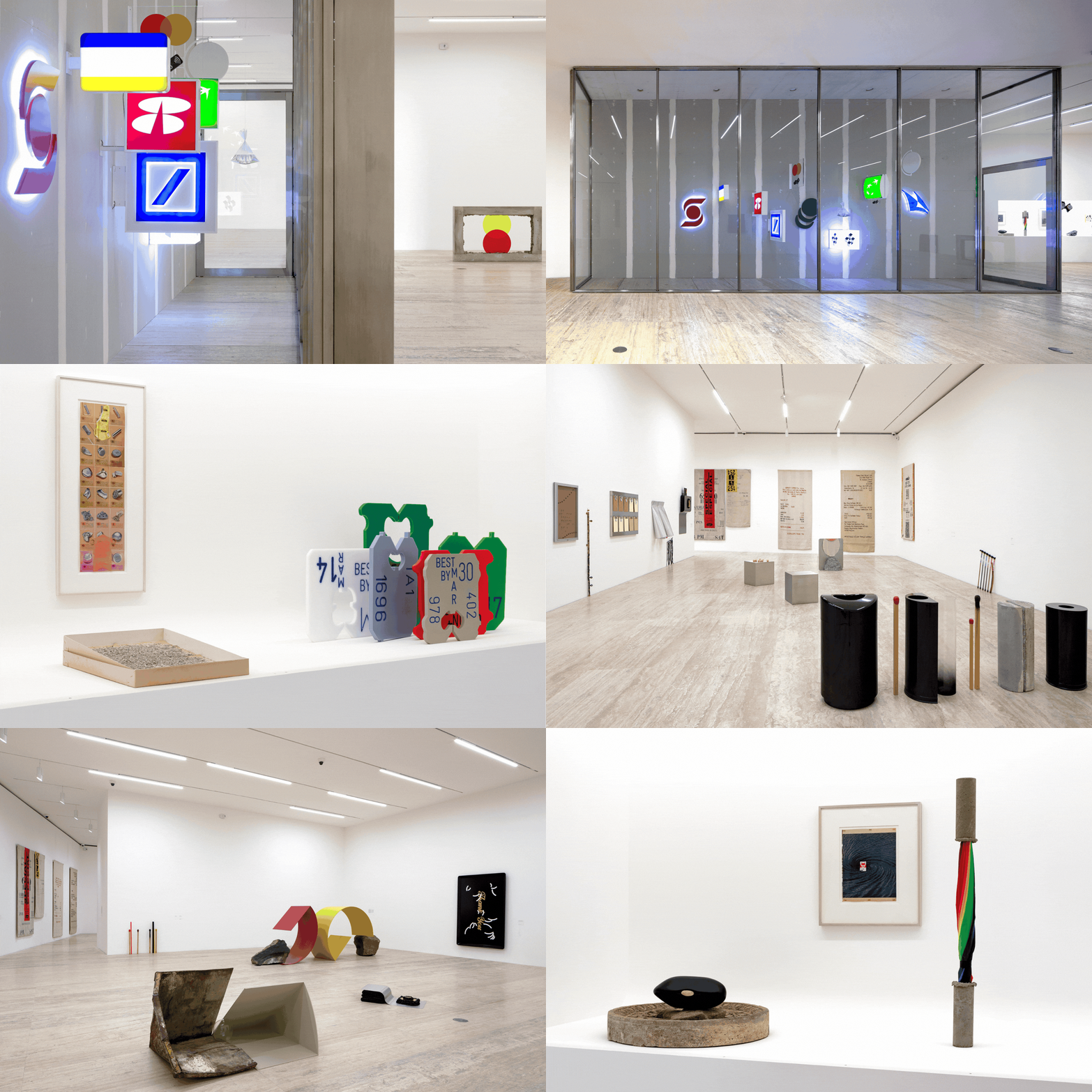
This inquiry into ordering principles has remained central to Kuri’s practice. Whereas at the Neue Nationalgalerie he reimagined an institutional mechanism, by 2019 he turned the logic of classification onto his own work. Gabriel Kuri: Sorted, Resorted—his first institutional solo exhibition in Brussels at the WIELS Contemporary Arts Center—approached the mid-career survey with deliberate irreverence. Rather than tracing a chronological or thematic arc, Kuri treated his entire œuvre as material to be processed, asking how it might be reclassified as waste. Borrowing the color-coded logic of municipal recycling, he divided more than sixty works into four categories: paper, plastic, metal, and construction materials. The framework was intentionally reductive, but by submitting his sculptures to the same systems that govern everyday disposal and circulation of waste, Kuri foregrounded both their arbitrariness and their governing force. As in Berlin a decade earlier, the exhibition became an extension of his method: a sorting device that made visible the structures through which society is organized.

Installation views of Gabriel Kuri: Sorted, Resorted, WIELS Contemporary Arts Center, Brussels, Belgium, 2019

Installation views of Gabriel Kuri: Sorted, Resorted, WIELS Contemporary Arts Center, Brussels, Belgium, 2019

Transactions and Consumption

For Kuri, art operates as a working protocol for inquiry. Rather than advancing arguments in words, he stages questions in form—about communication, value, and the structures of language, exchange, and power that organize experience. Sculpture becomes his method of thinking, a way to test reality through objects and situate those questions within the material systems that shape everyday life.

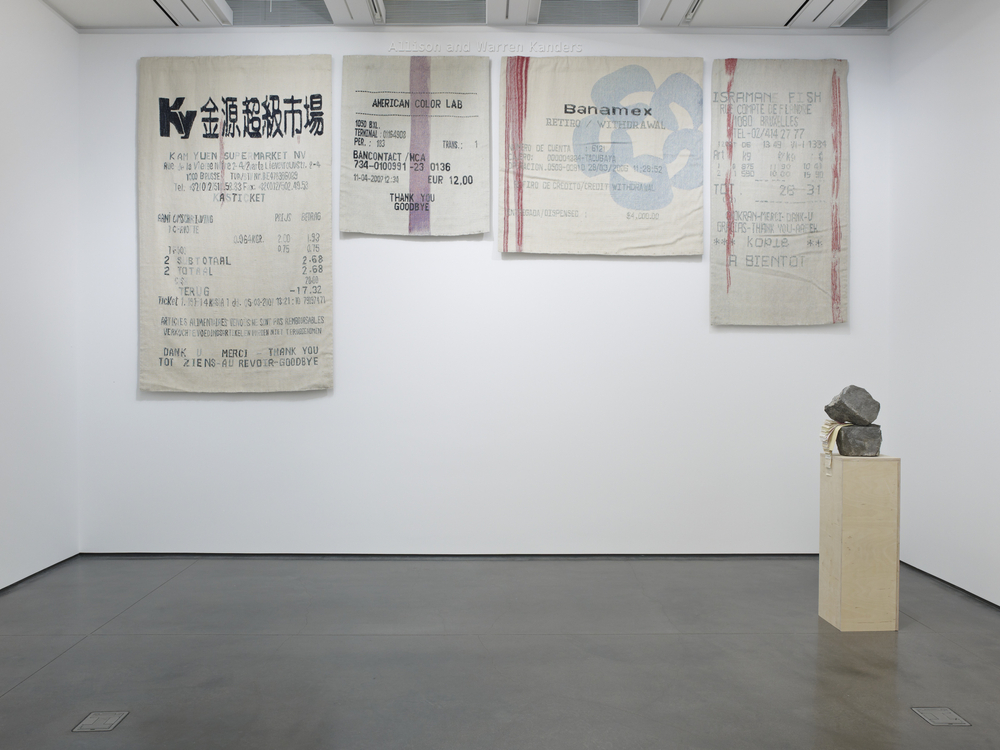
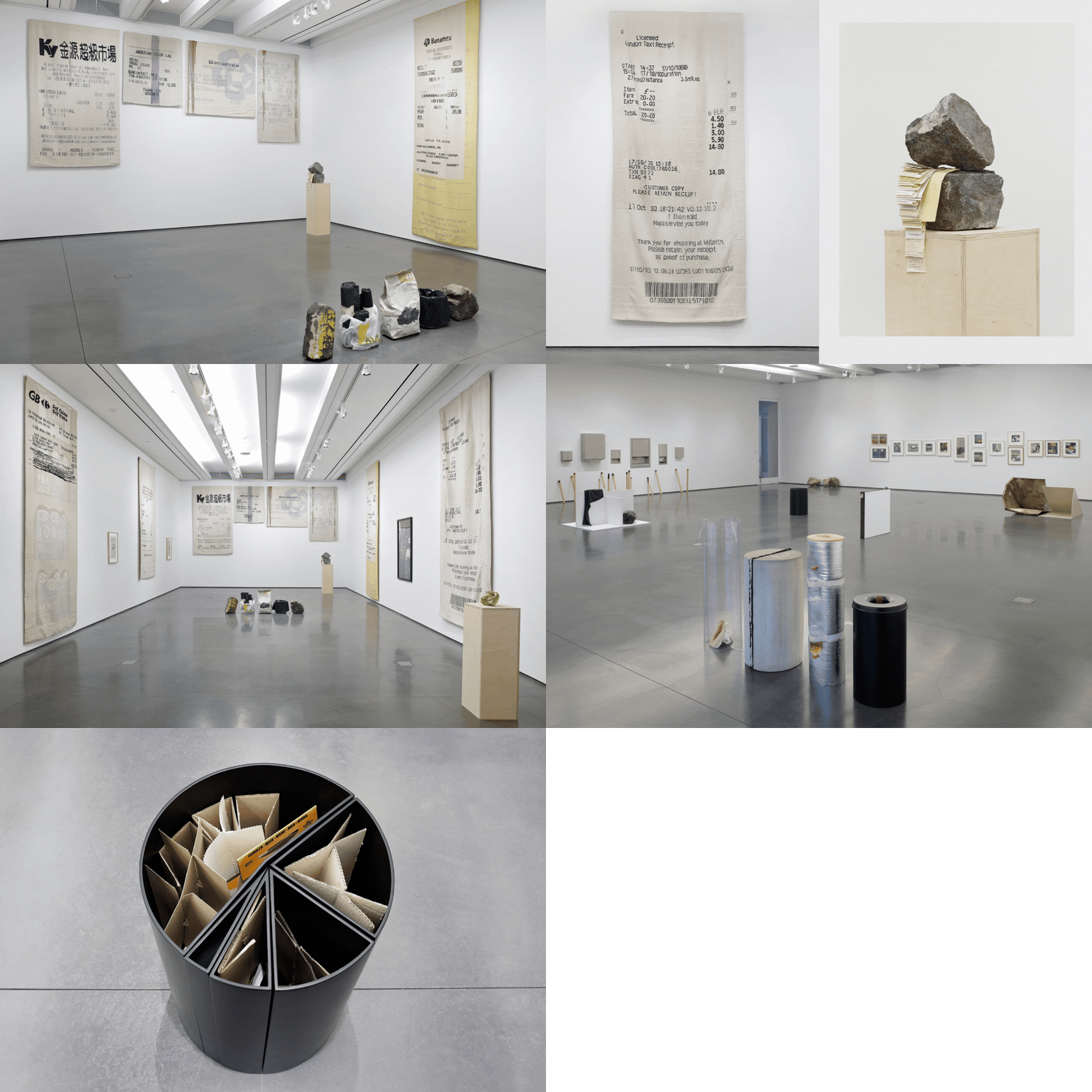
Installation view of Gabriel Kuri: with personal thanks to their contractual thingness, Aspen Art Museum, Colorado, 2014

Installation view of Gabriel Kuri: with personal thanks to their contractual thingness, Aspen Art Museum, Colorado, 2014

This inquiry has led him to work with the material traces left behind by economic transactions: receipts, tickets, plastic bags, even loose change that registers consumption. With this focus, his 2014 solo exhibition with personal thanks to their contractual thingness at the Aspen Art Museum gathered works that explore how transactions mediate and shape human interactions. Kuri isolates and reconfigures these everyday remnants of exchange, treating them not as inert data but as evidence of lived experience. This becomes tangible in the series of sculptures exhibited at Aspen, which he has produced since 2001, where he selects ephemeral tickets, vouchers, and receipts from his own movements—those that mark particular moments, locations, and expenditures—and translates them into handwoven wool gobelins. Through this slow, labor-intensive process, these fragile pieces of paper are transformed into lasting forms, prompting reflection on how transactions function as a form of biographical and economic portraiture, turning private movements and life choices into objects that circulate publicly as art.

Installation views of Gabriel Kuri: with personal thanks to their contractual thingness, Aspen Art Museum, Colorado, 2014

Installation views of Gabriel Kuri: with personal thanks to their contractual thingness, Aspen Art Museum, Colorado, 2014

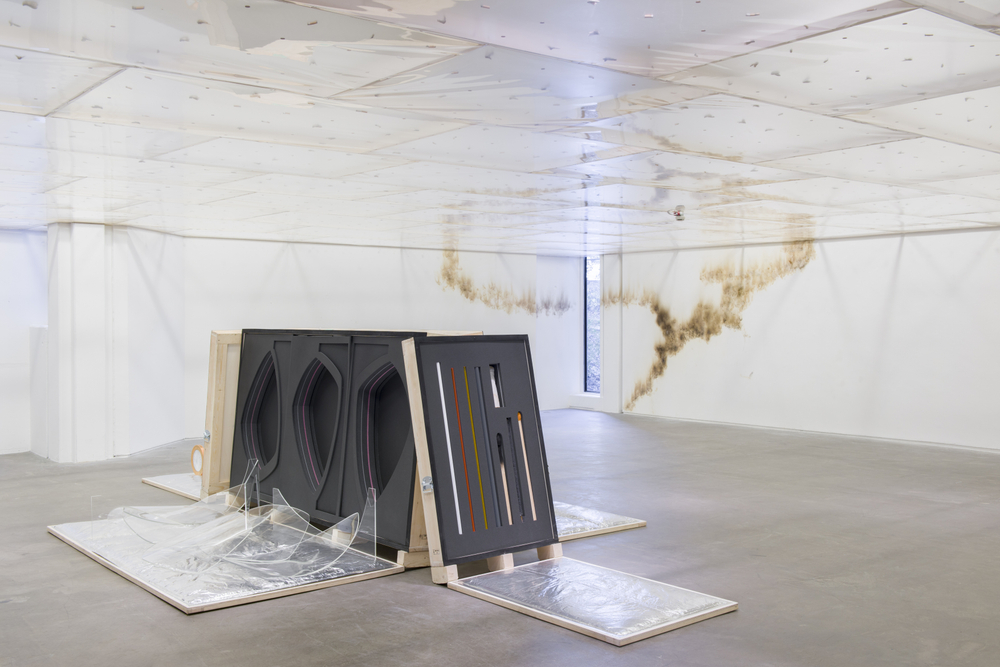
Installation view of spending static to save gas, Douglas Hyde Gallery, Dublin, Ireland, 2020

Installation view of spending static to save gas, Douglas Hyde Gallery, Dublin, Ireland, 2020

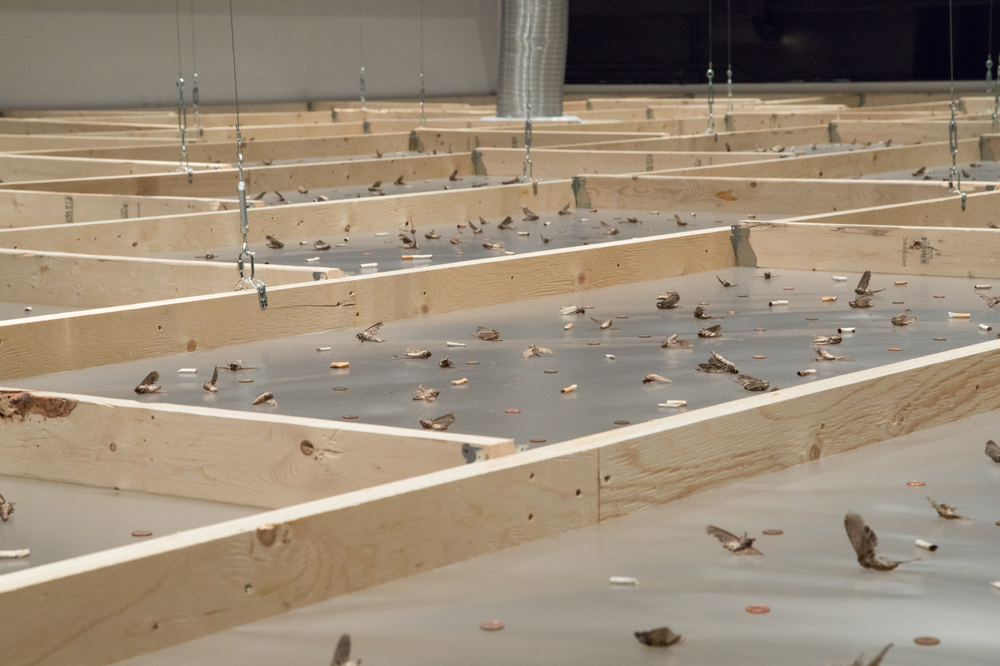
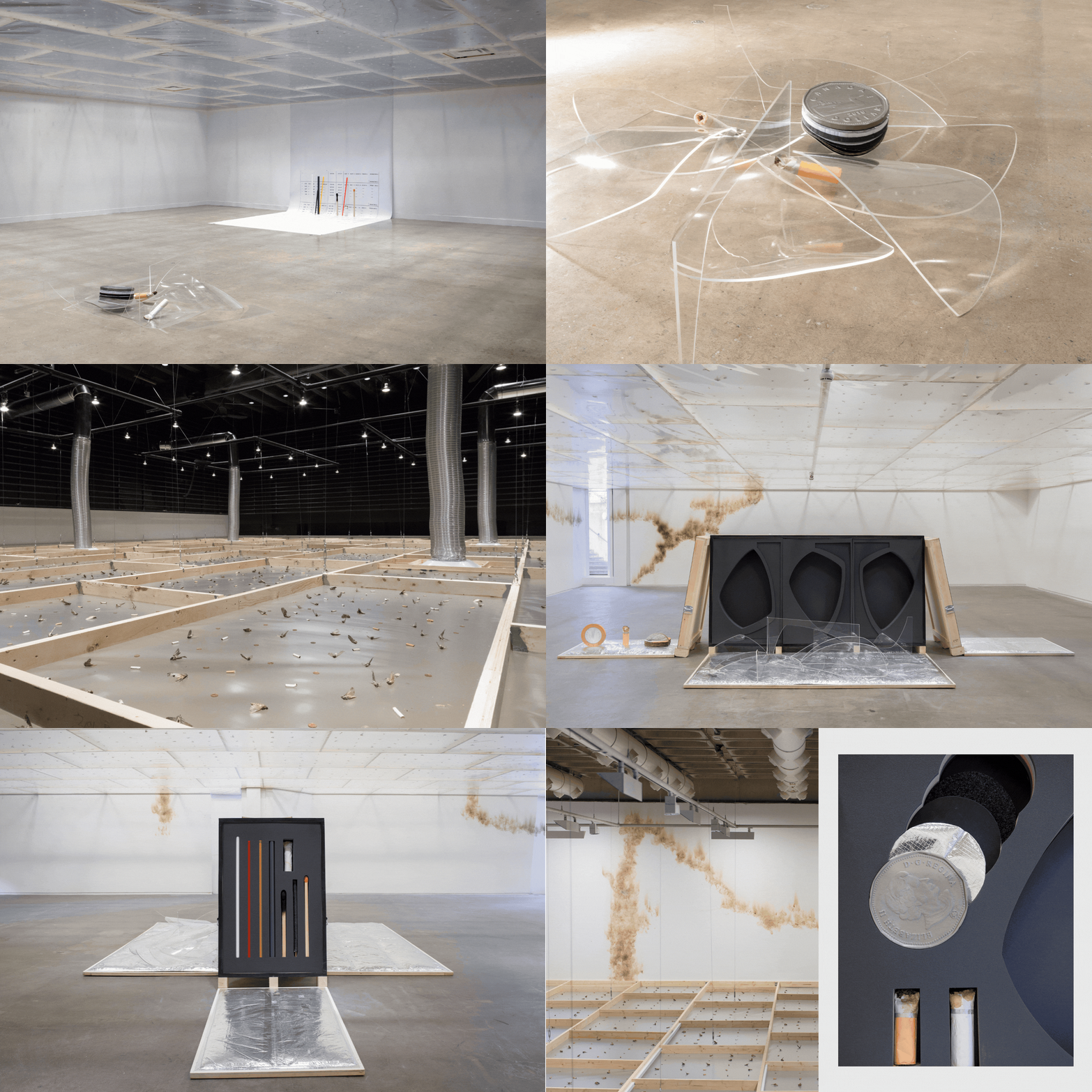
Having worked with the material traces of individual transactions, Kuri turned toward the infrastructures that frame them, shifting from the scale of the object to that of the institution in the project he developed first at Oakville Galleries in Ontario in 2018 and later at the Douglas Hyde Gallery in Dublin in 2020. In spending static to save gas, he began with a simple question: what would happen if the volume of a large gallery were cut in half to reduce its heating costs? In both venues, Kuri inserted a dropped ceiling that recalibrated their cavernous proportions, creating a static canopy designed to reduce energy use during the exhibition’s run.

Installation view of spending static to save gas, Oakville Galleries, Ontario, Canada, 2018

Installation view of spending static to save gas, Oakville Galleries, Ontario, Canada, 2018

The semi-transparent structure was punctuated with coins, cigarette butts, and moths—residues of human interactions and life, gathered in a grid of wooden frames. Smoke drawings that traversed the gallery walls were produced by burning sheets of paper printed with figures and charts relating to the logistics of the structural intervention and its projected savings. Enlarged matchsticks, coins and “error bars” translated statistical uncertainty into sculptural form. In both iterations, the exhibition functioned as a self-reflective proposition: a museum examining its architecture, costs, and the infrastructures of energy and labor on which it depends.

Installation views of spending static to save gas, Douglas Hyde Gallery, Dublin, Ireland, 2020, and Oakville Galleries, Ontario, Canada, 2018

Installation views of spending static to save gas, Douglas Hyde Gallery, Dublin, Ireland, 2020, and Oakville Galleries, Ontario, Canada, 2018

Material as Meaning

Installation view of ILLUMInations, 54th International Art Exhibition at the Venice Biennial, 2011

Installation view of ILLUMInations, 54th International Art Exhibition at the Venice Biennial, 2011

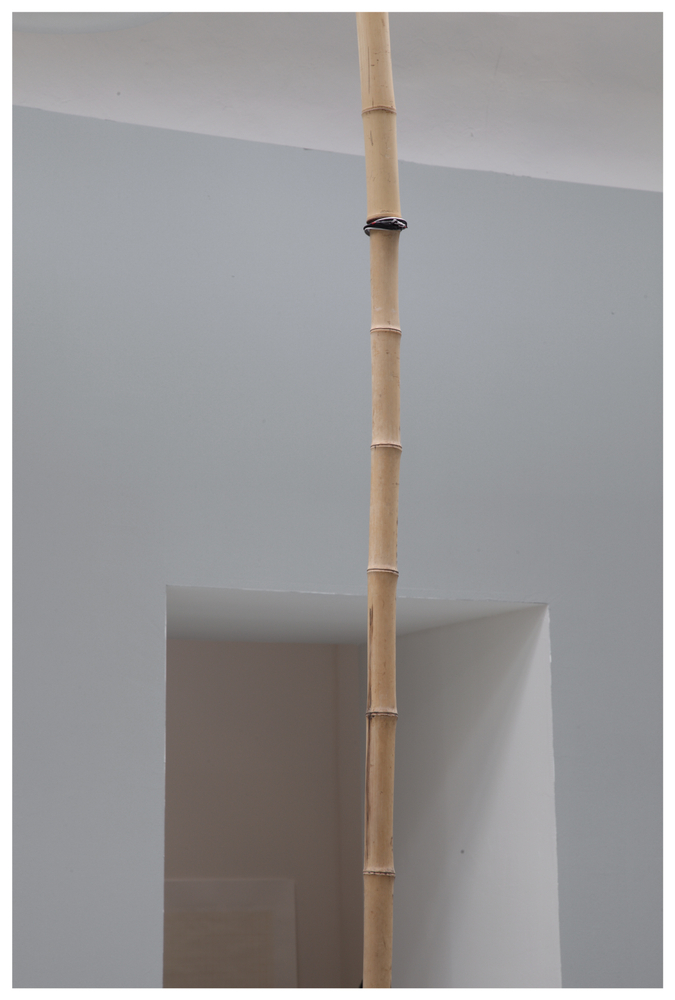
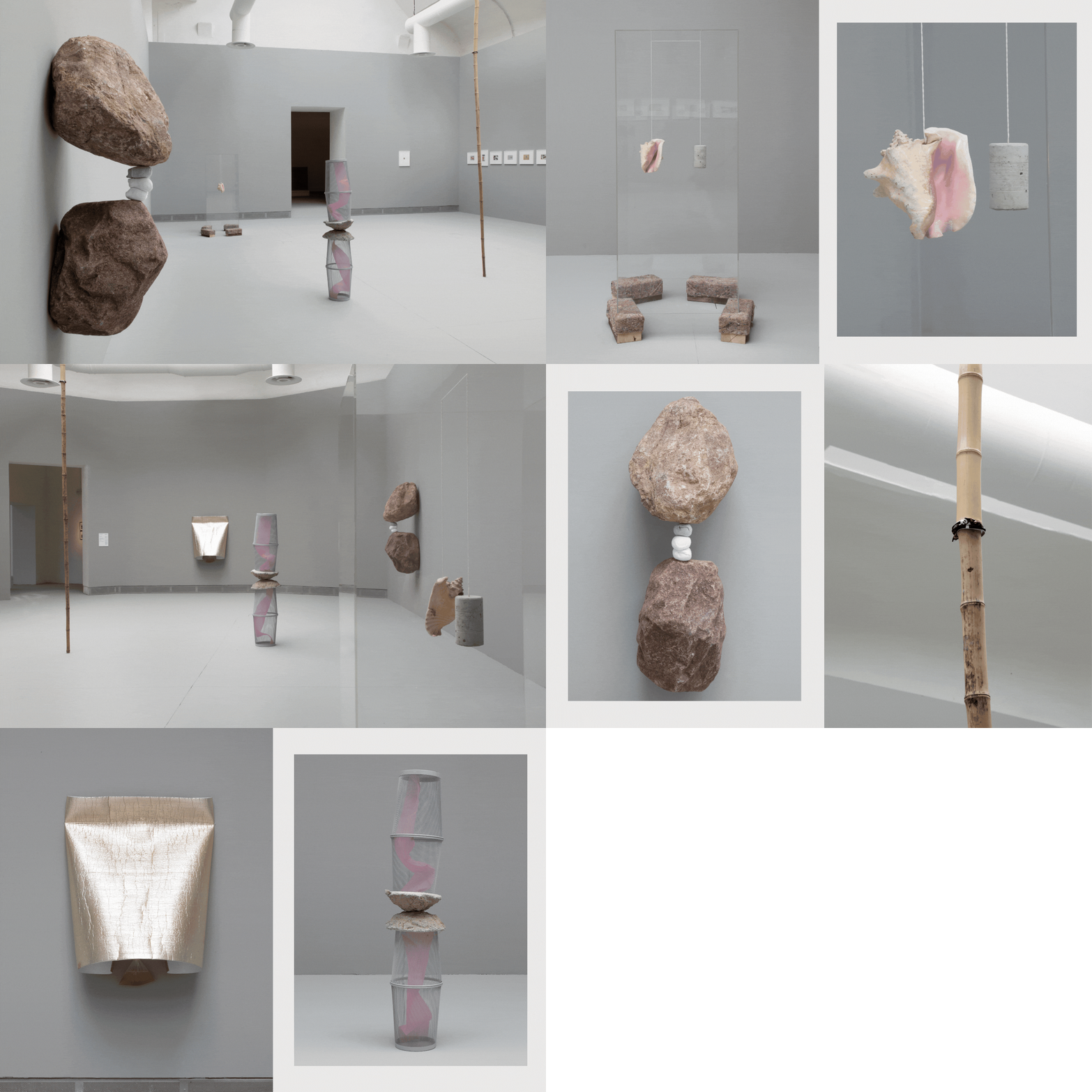
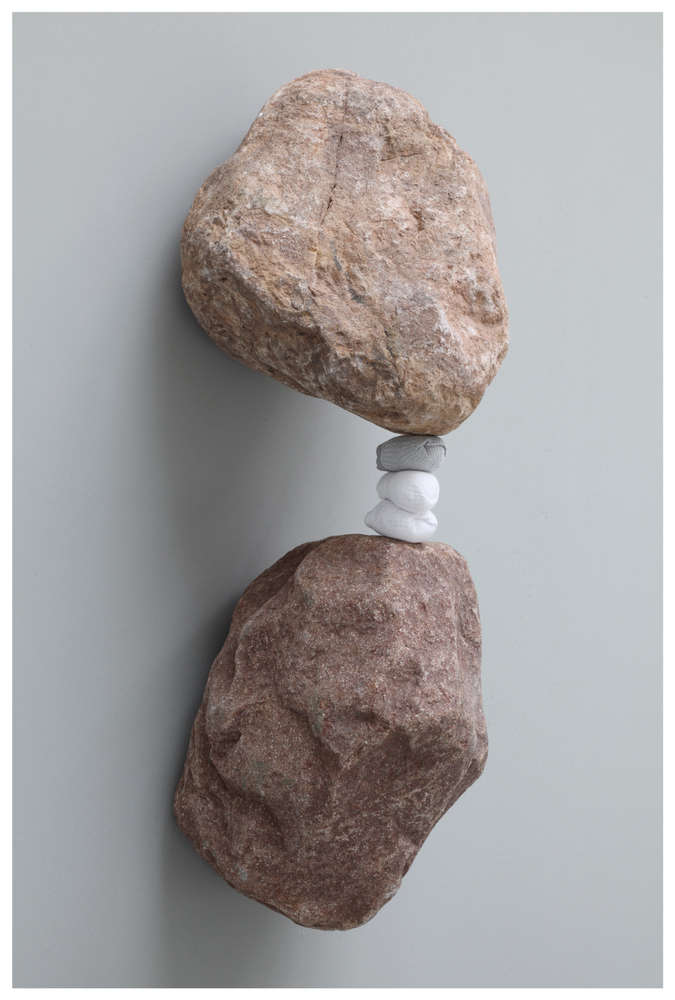
Contrast and juxtaposition are key principles in many of Kuri’s works, as is a dialectical structure in which opposing forces generate new meaning. As seen in earlier works where soft coats and bags negotiated with his metal structures, these tensions recur throughout his practice: heavy and light, hard and soft, durable and ephemeral. This sculptural language, grounded in the friction between disparate materials, came into focus in his presentation at ILLUMInations, the 54th International Art Exhibition at the Venice Biennale curated by Bice Curiger in 2011. Within the Giardini, Kuri staged calculated pairings: bamboo poles balanced on a crushed Coca-Cola can, held between floor and ceiling; two boulders hung on the wall, improbably supported by three balled-up socks. These juxtapositions nod to Surrealist strategies of unlikely encounter, yet their force lies less in visual surprise than in the way materials accrue meaning through their physical and cultural associations.

Installation views of ILLUMInations, 54th International Art Exhibition at the Venice Biennial, 2011

Installation views of ILLUMInations, 54th International Art Exhibition at the Venice Biennial, 2011

Installation views of Three Arrested Clouds (2010), as part of ILLUMInations, 54th International Art Exhibition at the Venice Biennale, 2011

Installation views of Three Arrested Clouds (2010), as part of ILLUMInations, 54th International Art Exhibition at the Venice Biennale, 2011

Three Arrested Clouds (2010) emerged from Kuri’s experience living in Brussels and  missing mountainous landscapes. Moved by the view of clouds drifting across the mountains seen from the Museion (Museum of Modern and Contemporary Art Bolzano) in Italy, where he was installing a solo exhibition, he sought to capture that image by inserting socks—recurring elements in his work—into the negative space between stones. The work has also been read in dialogue with Magritte’s depictions of clouds and rocks,[1] a comparison that underscores how material arrangements can activate art-historical memory alongside personal references. As Kuri notes, “all materials, no matter how raw they appear… are socially branded and coded.” [2] Each material carries accumulated associations that exceed its physical properties. If “materials are in fact circumstances,” as Kuri suggests, then their social charge becomes inseparable from their form. [3]

Installation view of All probability resolves into form, The Common Guild, Glasgow, United Kingdom, 2014

Installation view of All probability resolves into form, The Common Guild, Glasgow, United Kingdom, 2014

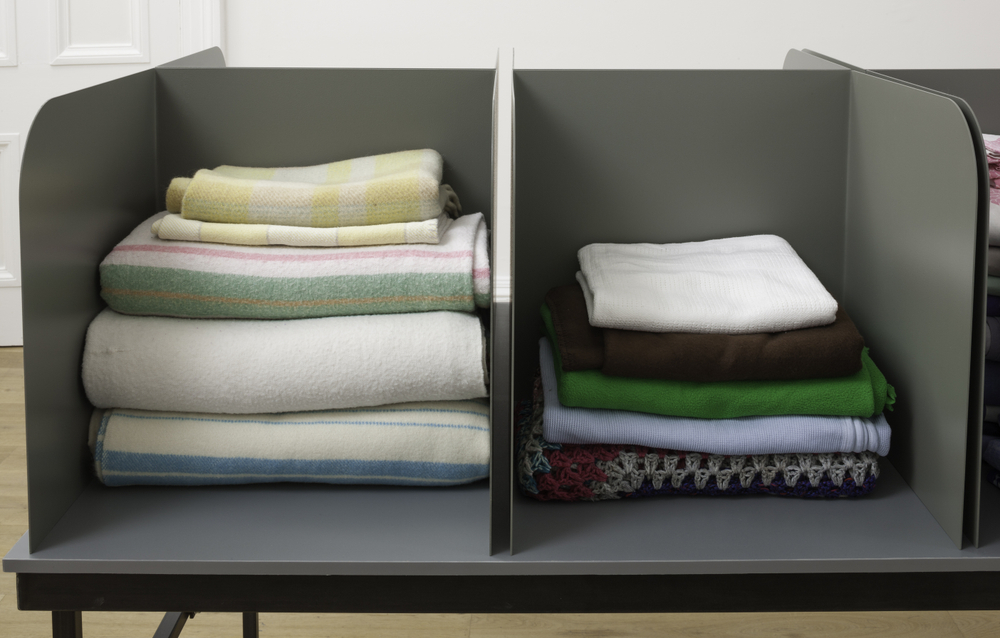
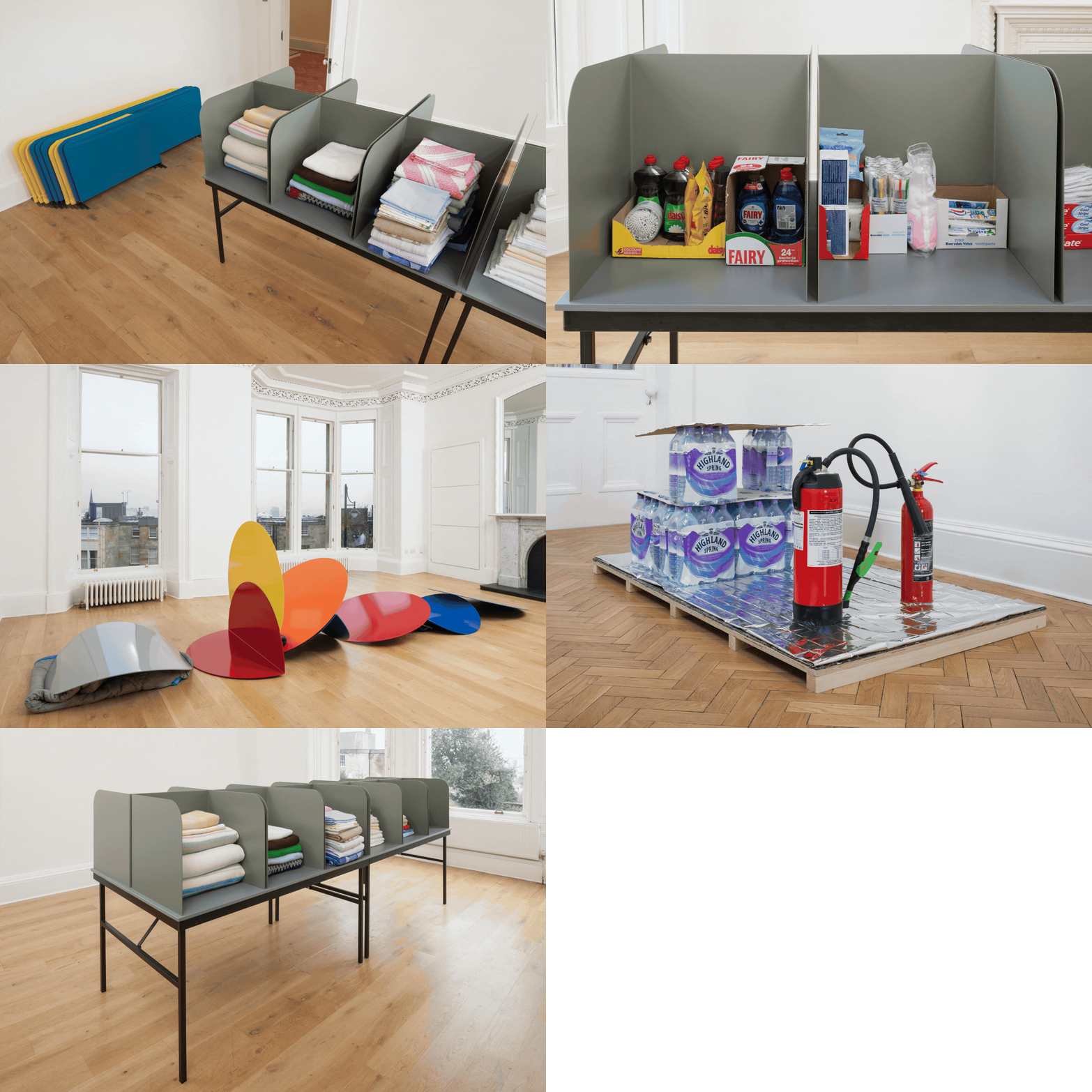
This premise underpinned his 2014 solo exhibition at The Common Guild in Glasgow, All probability resolves into form, where he turned to the architectures of disaster shelters and polling stations—provisional structures that condense questions of governance, aid, and collective vulnerability. Taking voting booths and relief centers as points of departure, his sculptures examined how materials operate within specific political and economic frameworks. A public call for basic necessities—blankets, sleeping bags, bottled water, toiletries—brought donated items into the gallery alongside elements fabricated in his studio.

Installation views of All probability resolves into form, The Common Guild, Glasgow, United Kingdom, 2014

Installation views of All probability resolves into form, The Common Guild, Glasgow, United Kingdom, 2014

Detail of Balance of the Invisible and the Foreseeable, 2014

Detail of Balance of the Invisible and the Foreseeable, 2014

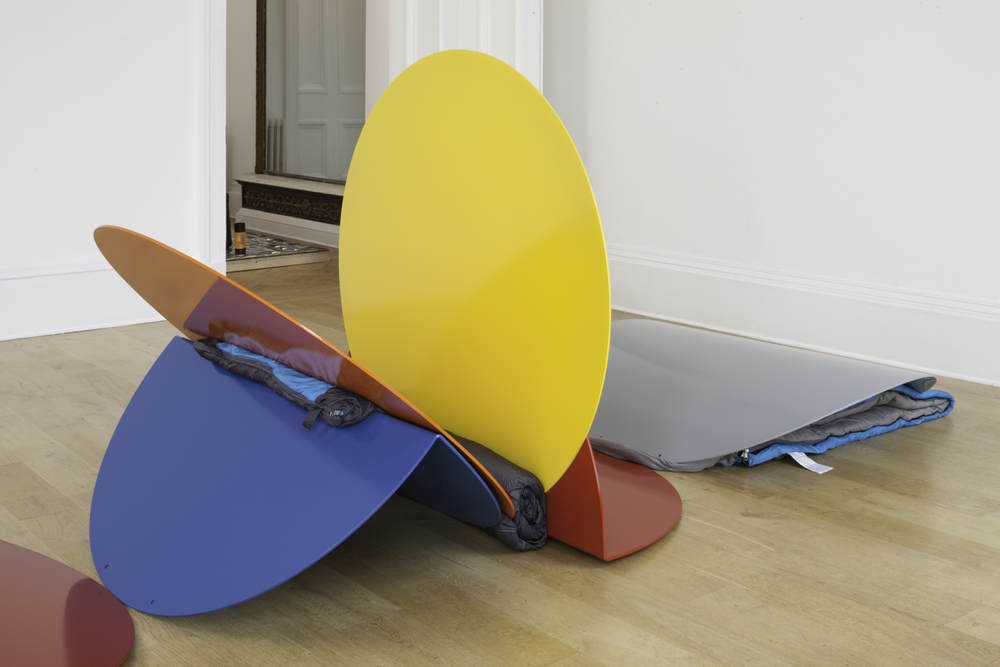
In Balance of the Invisible and the Foreseeable (2014), multicolored metal discs lean precariously against one another, sleeping bags wedged beneath and between them. While formally indebted to minimalism and geometric abstraction, the work points to the social consequences of financial systems: the discs’ bright colors recall credit card logos, while the sleeping bags evoke homelessness and economic precarity. At the exhibition’s conclusion, the usable materials were donated to charities supporting individuals made destitute—often following refused asylum claims—as well as other vulnerable migrants without recourse to public funds.

Forms of Prediction

By the early 2020s, Kuri’s engagement with systems of organization and exchange had expanded to consider how the future itself is structured and anticipated. Forecast marked his first large-scale institutional survey in Mexico. Rather than attempting a comprehensive retrospective, the 2023 exhibition at Museo Jumex brought together more than fifty works from the previous decade that could be seen as forms of prediction, embodiments of what may come. Many referenced predictive models drawn from behavioral economics, meteorology, volcanology, product testing, and the credit system, underscoring how different disciplines seek to manage uncertainty by translating it into data, signs, and risk calculations.

Installation views of Gabriel Kuri: Forecast, Museo Jumex, Mexico City, 2023

Installation views of Gabriel Kuri: Forecast, Museo Jumex, Mexico City, 2023

Detail of Forecast, 2023

Detail of Forecast, 2023

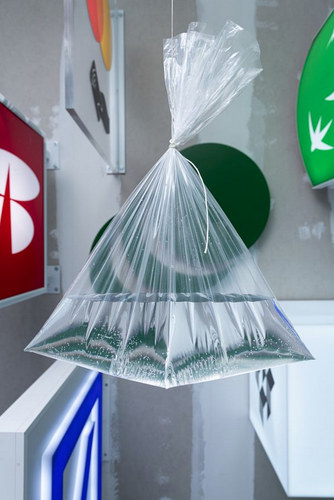
The installation that lent the exhibition its title, Forecast (2023), occupied the museum’s glazed terrace like a suspended commercial vitrine. Banking and credit card signs hung as in a shop window, their text erased so that only logos remained: abstract constellations of circles and stars. These symbols retained the aesthetics of corporate branding while aligning the credit system’s promise of deferred prosperity with astrology’s search for omens. Among them hung a plastic bag filled with water, borrowed from everyday markets in Mexico and reputed to repel flies. Positioned alongside the language of finance, it introduced a vernacular logic of belief into a space governed by calculation, suggesting that minor gestures and informal knowledge persist within—and can subtly unsettle—the economic systems that claim to forecast the future. Kuri’s turn to forecasting extends his longstanding inquiry into how we navigate such structures, weighing possible scenarios to anticipate or negotiate the systems that organize collective life.

Installation view of untitled (-2/3) (2025), as part of your cost-benefit calculations, kurimanzutto, New York, 2026 

Installation view of untitled (-2/3) (2025), as part of your cost-benefit calculations, kurimanzutto, New York, 2026 

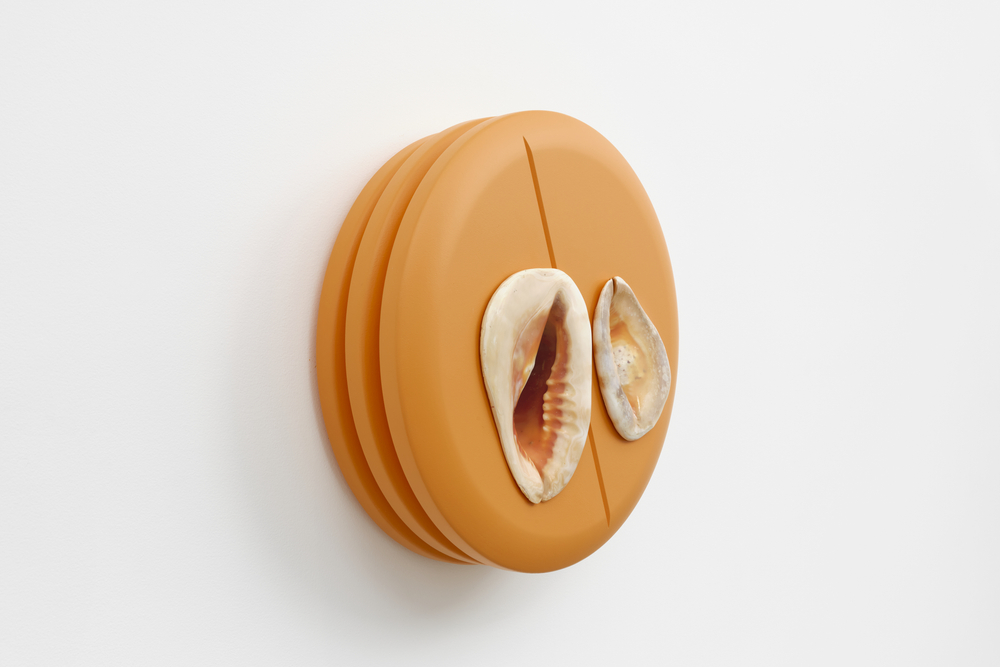
The works included in your cost-benefit calculations at kurimanzutto, New York, extend these questions by asking how probability itself might assume material form. The title invokes the phrase that guides countless daily decisions—choices shaped as much by instinct as by reason—and the subtle assessments through which risk and chance become tools for imagining what lies ahead. Through folded steel, textiles, volcanic rocks, carved wood, and consumer objects, Kuri tests how abstract operations can register concretely. Rather than posing a rhetorical question, the exhibition proposes that materials can embody the language of odds, inviting viewers to sense how the future is calculated, anticipated, and negotiated in the present.

Installation views of your cost-benefit calculations, kurimanzutto, New York, 2026

Installation views of your cost-benefit calculations, kurimanzutto, New York, 2026

[1] Gabriel Kuri in conversation with Sofía Hernández Chong Cuy, “While Arrested Clouds,” in with personal thanks to your contractual thingness (Aspen: Aspen Art Press, 2015), 136.

[2] Gabriel Kuri, quoted in Catherine Wood, “Sculpture in Solid Air,” in Gabriel Kuri: Soft Information in Your Hard Facts (Bolzano, Italy: Museion, 2010), 99.

[3] "Finder Keeper: The Art of Gabriel Kuri." Getty Conservation Institute. October 19, 2016. Youtube Video, https://www.youtube.com/watch?v=uRxykBjLJgc&t=1s